Training

What we train.

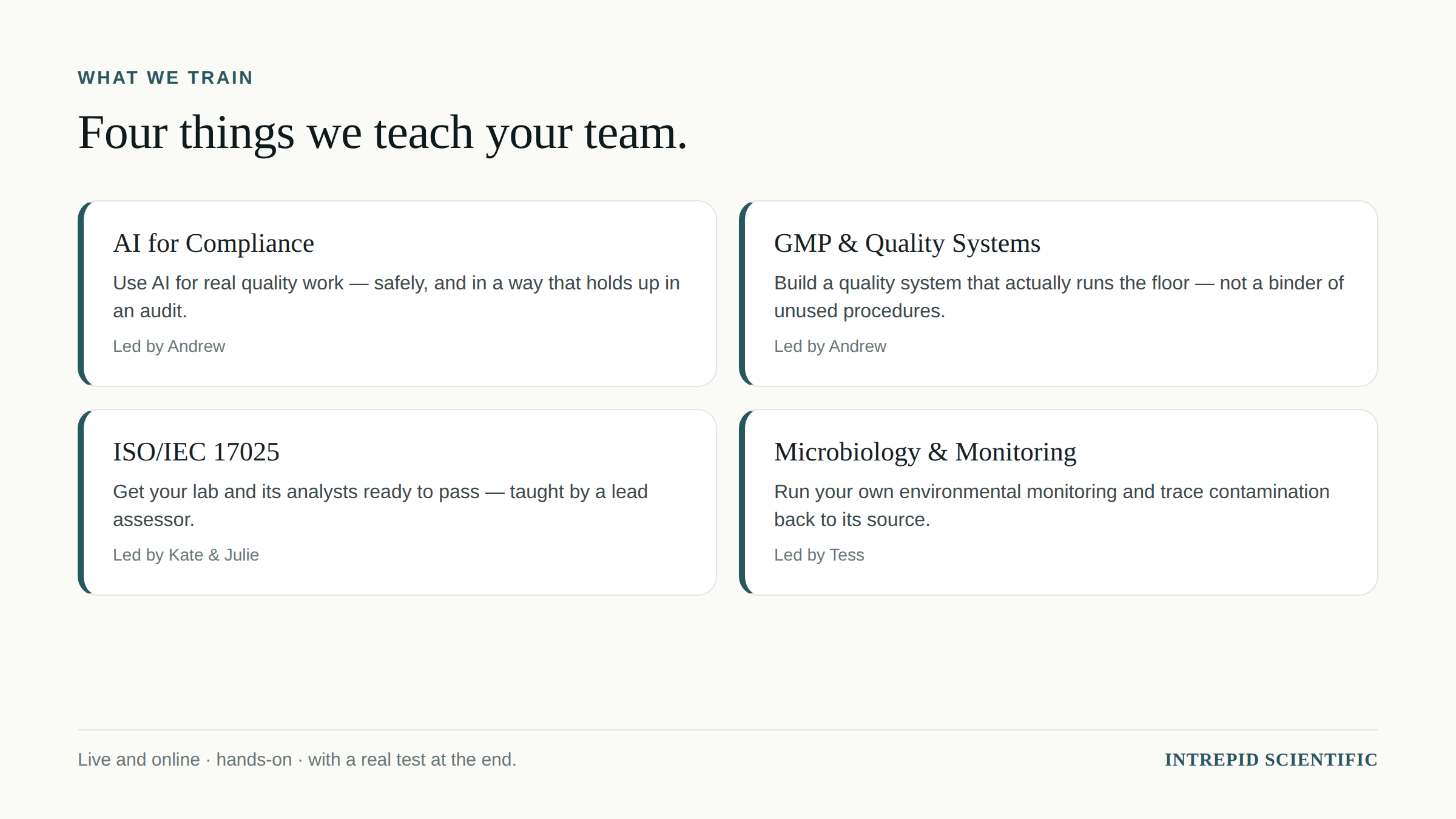
Four pillars, taught by the same senior scientists who do the work on our engagements — an ISO 17025 lead assessor, an ASTM cannabis QMS subcommittee chair, an AOAC working-group chair, and a university aerobiology researcher. Practitioner-taught, not consultant-recited. Remote-first, hands-on, and graded on real competency.

The four pillars

Jump to any pillar. Every program runs live and virtual by default; on-site delivery is available where walking your facility or running multi-instructor breakouts earns the travel.

How we train

The same principles that run our engagements run our training. We develop your people; we don’t hand them slides.

Remote-first. On-site when it earns its place.

Every program runs live and virtual by default — lower cost, no travel, easier to schedule across a team. We bring it on-site when walking your facility or running multi-instructor breakouts is worth the trip.

Hands-on. Bring your own data.

Participants rework their own SOPs, COAs, and validation data in the room. Co-development, the way our engagements run — you leave having done the work, not watched it.

Graded competency, not a certificate of attendance.

Every program ends in a real assessment. You learn whether your people can actually do the work, not whether they sat through the slides.

Artifacts you keep.

Everyone leaves with templates and a working draft — an AI-use SOP, an EM protocol, a validation dossier skeleton, an internal-audit checklist — built on your own context.

Intrepid advises, builds, and trains. The client operates the system.

Training is how we develop your people to run the system themselves. Same sharp role boundary as the rest of the firm.

We'll tell you if you don't need the full program.

Each pillar pairs with a consulting line, but training is the wedge, not the upsell. If a half-day briefing is all your team needs, that's what we'll recommend.

Pricing

Two ways to bring us in

Most teams book a private cohort — one flat fee for your group (up to ~12 participants), with the agenda tailored to your regulatory target. Starting floors are listed on each pillar below. When you’d rather send one or two people, we also run scheduled public sessions per pillar at a per-seat rate.

Public session — per seat

Executive briefing

½ day

$350 / seat

Workshop

1 day

$950 / seat

Intensive

2 days

$1,800 / seat

Public sessions run on a published schedule; minimum six seats to confirm a date.

How the numbers work

  • ·Floors are sized for cannabis-operator scope. Pharmaceutical, CMO, and laboratory engagements carry more regulatory depth and quote higher. The final fee is set at intake.
  • ·Private cohorts cover up to ~12 participants; additional seats are billed per head. A multi-discipline on-site intensive can field a second cofounder for an added daily fee.
  • ·Add-ons: a post-training compliance retainer from $3,500/mo, and the AI pillar flows into the AI Compliance Jumpstart for tooling setup and a Claude Project handoff.
  • ·Custom and train-the-trainer work bills in quarter-hour increments with a running ledger on every invoice — the same operational hygiene as our engagements.

The curriculum

Four pillars, one faculty

Each pillar is owned by the cofounder who works in it. Scope is shown below; specific agendas are tailored to your team and your regulatory target during scheduling.

AI for Compliance

Use AI to do real quality and regulatory work — defensibly, and without putting your data or your filings at risk. Taught by people who use these tools daily across live GMP and ISO 17025 engagements, not from the outside looking in.

Who it’s for

QA and RA leaders, lab directors, and compliance teams who are already pasting documents into chatbots — usually without governance — and want to do it well, in the open, instead of quietly.

What we cover

  • ·The honest landscape — what AI does well in compliance work, where it fails, and the failure modes that earn a 483 or a data-integrity finding
  • ·Governing AI under your QMS — drafting an AI-use SOP, acceptable-use boundaries, the human-in-the-loop review gate, and the records that prove a human owned the decision
  • ·Data protection — what may never leave the building, on-prem vs. cloud, redaction discipline, and configuring tools so client and patient data is never exposed
  • ·High-value, defensible use cases — SOP and protocol drafting, gap analysis against a regulation, deviation and CAPA narrative drafting, document-control QC, training-material generation, and regulatory research with citation verification
  • ·The skills that make it work — prompting for regulated work, grounding outputs in your own controlled documents, and verifying every claim and citation before it enters a record
  • ·Hands-on — build a governed workflow on a real task from your own shop, and leave with a working AI-use SOP draft

Formats

Live virtual workshop

Remote · default

from $7,500

One day, hands-on. Build a governed workflow on your own task and leave with an AI-use SOP draft.

Executive briefing

Remote · half-day

from $2,500

Awareness and governance for leadership — risk, boundaries, and where AI belongs in your QMS.

On-site

Available

from $12,000 + travel

Delivered at your site for a full team. Pairs with a Claude Project / tool-setup handoff toward the AI Compliance Jumpstart.

Who leads

Andrew Samann (GMP / QMS / regulatory lead; founder of Orion GMP Solutions; uses these tools daily across live compliance engagements).

AI is already in your quality system whether you've approved it or not. The risk isn't using it — it's using it ungoverned.

GMP & Quality Systems

Build and run a quality system an EU GMP, FDA, or Health Canada auditor will respect — not a binder of SOPs that never reached the floor. Taught by someone who has led 100+ GMP builds and chaired the ASTM D37.02 cannabis QMS subcommittee. Covers the GxP family, with a GACP sub-track for cannabis cultivation.

Who it’s for

Pharma and CMO QA teams; cannabis manufacturers pursuing EU GMP export readiness or state cGMP; food and dietary-supplement makers under FSMA.

What we cover

  • ·QMS architecture — document hierarchy (policy → SOP → work instruction → record), the controlled-documents list, change control, and why the system has to live on the floor, not in a binder
  • ·Data integrity & ALCOA+ — the deepest-graded module: contemporaneous records, audit trails, and the specific behaviors that generate data-integrity findings
  • ·Deviations, investigations & CAPA done right — root-cause rigor, effectiveness checks, and the investigation quality auditors actually probe
  • ·Risk management & contamination control — ICH Q9 quality risk management, building a Contamination Control Strategy under Annex 1, and risk-zoning a facility
  • ·Qualification & validation lifecycle — URS → DQ → IQ / OQ / PQ → PV, the trace matrix that proves design met requirement, and the nine immutable questions every export-readiness auditor asks on day one
  • ·Audit readiness — mock-audit behavior, the day-one questions, and how to present a system without talking yourself into a finding
  • ·GACP sub-track (cannabis cultivation) — good agricultural and collection practices bridging the grow into a GMP manufacturing flow

Formats

Modular virtual series

Remote · default

from $9,500

Half- to full-day modules that recombine into a pharma, cannabis-manufacturer, or FSMA track from one library.

On-site intensive

Available

from $20,000 + travel

Two-day flagship at your facility, with live workshop blocks on your own SOPs.

Train-the-trainer

Remote or on-site

from $22,000

Build and qualify your internal QA training program so you can sustain it after we leave.

Who leads

Andrew Samann (EU GMP, ICH Q7 lead auditor across 100+ engagements; certified multiple Canadian cannabis Licensed Producers; previously led the ASTM D37.02 QMS Subcommittee for Cannabis).

The most common failure we see is the paper system that never ran the floor. We teach the difference between having a document and running a system.

ISO/IEC 17025 Accreditation

Get a lab — and its analysts — ready to pass an initial assessment and stay accredited. Taught by an ANAB and A2LA lead assessor who sits on the other side of the table, alongside a method-validation specialist who has built the dossiers assessors read.

Who it’s for

Cannabis and hemp testing labs; pharma and contract analytical labs; greenfield lab startups; and existing labs prepping for a surveillance assessment or a scope expansion.

What we cover

  • ·The standard, clause by clause — ISO/IEC 17025:2017 structural, resource, process, and management-system requirements, in plain language with the assessor's emphasis
  • ·Impartiality, confidentiality & decision rules — the management-system clauses labs most often fumble, and building defensible decision rules and conformity statements
  • ·Method validation & verification — validating in-house methods vs. verifying compendial ones (USP <1225>/<1226>, ICH Q2(R2)), and building a dossier an assessor will accept
  • ·Measurement uncertainty — estimating and documenting MU budgets per EURACHEM/CITAC, the step most labs skip and most assessors flag
  • ·Proficiency testing — selecting schemes, handling results, and corrective action on a failed PT
  • ·Quality manual & document control — the management-system documents, ALCOA+ data control, and nonconforming-work handling
  • ·Internal audit & management review — running both so there is real evidence before the accreditation body arrives, because the AB requires it
  • ·Surviving the assessment — the mock-assessment walkthrough, the common findings, and writing corrective actions that close on the first pass

Formats

Clause-by-clause series

Remote · default

from $9,500

Live virtual walkthrough of the standard with the assessor's emphasis, plus method-validation and MU sessions.

Internal-auditor training

Remote · competency-graded

from $7,500

Qualify your own internal auditors — the function the AB expects evidence of before assessment.

Assessment-prep bootcamp

Available · on-site

from $20,000 + travel

Intensive ahead of a scheduled AB visit, including a mock walkthrough.

Who leads

Kate Evans, PhD (ANAB and A2LA lead assessor — assessor-side perspective is the differentiator; Technical Contact, ASTM D8493-23) leads, with Julie Kowalski, PhD (analytical chemistry method development and validation; past chair, AOAC CASP Pesticide Think Tank) on method content.

Labs fail on the same predictable things. We teach to exactly what an assessor looks for — because one of us is the assessor.

Microbiology & Environmental Monitoring

Stop guessing why your product fails micro. Learn to run your own environmental monitoring and trace contamination to its root cause — before the testing lab does it for you. Taught by a researcher who studies cannabis bioaerosols in built environments for a living.

Who it’s for

Cannabis cultivators and processors (primary); food and dietary-supplement makers; and any facility fighting recurring yeast and mold, Aspergillus, Salmonella, or gram-negative failures.

What we cover

  • ·Microbiology fundamentals for non-microbiologists — what the organisms are, where they come from, what the results mean (USP <61>/<62> and state-method context), and why a number on a COA is a symptom, not a diagnosis
  • ·Building an environmental monitoring program — sample-site selection (air and settle plates, surface swabs, water, personnel), establishing alert and action limits, sampling frequency, and trending so the data tells you something
  • ·Doing your own monitoring — practical sampling technique, what to handle in-house vs. send out, and coordinating with the testing lab for species-level ID
  • ·Root-cause investigation — reading COA failure patterns by room, strain, harvest week, and biological-input timing to rank contamination vectors as a repeatable skill
  • ·Bioaerosols & the built environment — airflow, HVAC, humidity, and personnel as contamination routes; characterize, monitor, mitigate
  • ·Contamination control & sanitation — sanitation SOPs, hold/test/release corrective actions, and a preventive-controls mindset modeled on FSMA 21 CFR Part 117
  • ·Hands-on — map your own facility's sample sites and draft an EM protocol for your real rooms

Formats

EM-program-design series

Remote · default

from $7,500

Live virtual program build — sample sites, limits, trending — culminating in a draft EM protocol for your rooms.

Facility workshop

Available · on-site

from $12,000 + travel

Walk your actual rooms to map sample sites and contamination routes. The highest-value format here.

With root-cause engagement

Add-on

Within engagement scope

Pairs with the Microbial Root-Cause Investigation consulting line as the “teach your team to run it” handoff.

Who leads

Tess Eidem, PhD (PCQI; Senior Research Associate, University of Colorado Boulder Aerobiology and Disinfection Lab; cannabis-bioaerosol characterization, monitoring, and mitigation).

A failed COA costs a harvest. Most micro failures aren't bad luck — they're a traceable contamination vector.

Train your team

Tell us which pillar, who’s in the room, and what you’re preparing for. We reply directly, from the cofounder who teaches it, and tailor the agenda to your team.