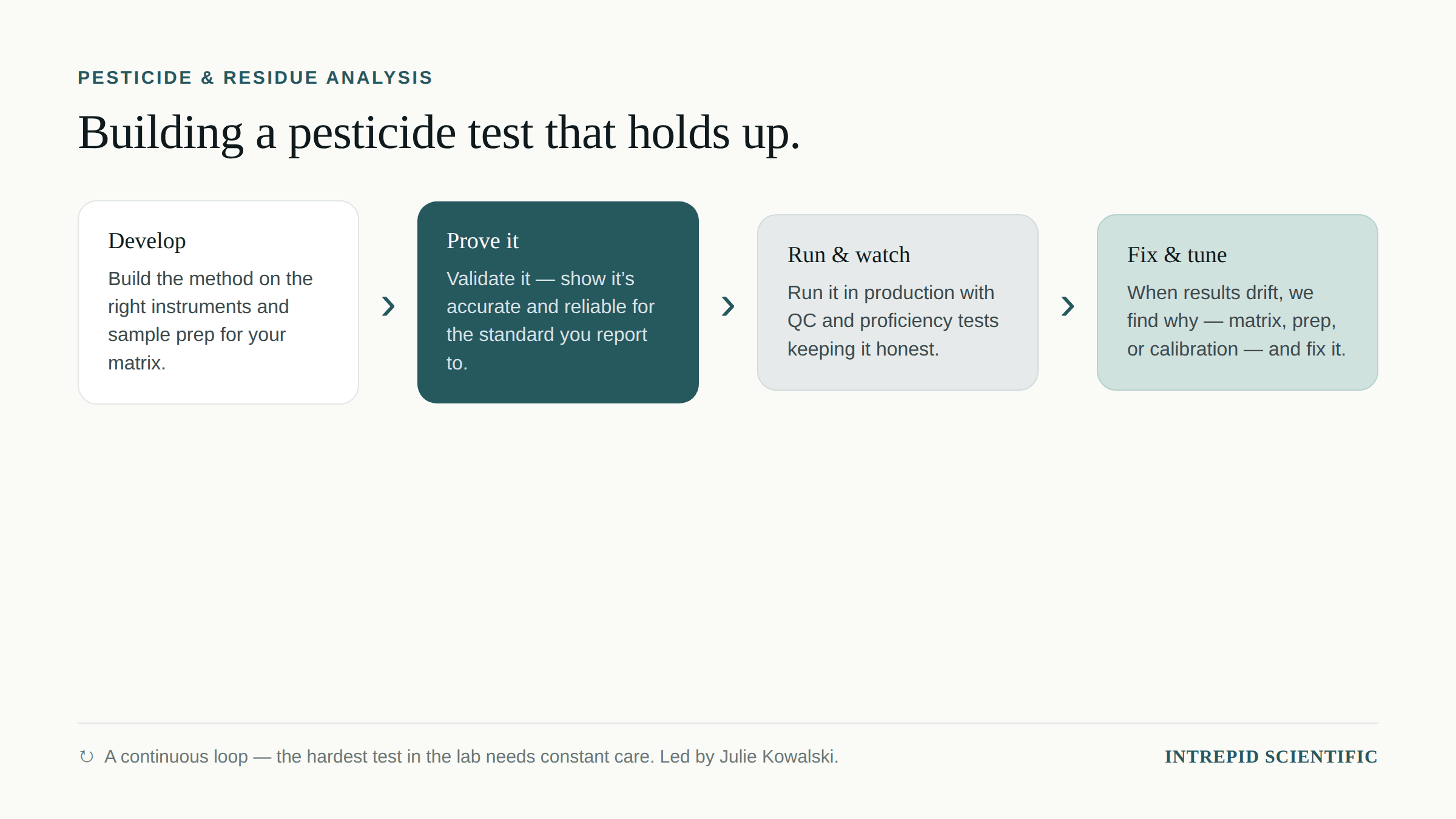
The full range of pesticide and residue work, all led by Julie. Every engagement is scoped during intake — method difficulty depends on the matrix, the target list, and your instruments, so we scope honestly, never from a list.
Pesticide Method Development & Validation
Develop and validate multiresidue pesticide panels — LC-MS/MS and GC-MS/MS — for cannabis, hemp, food, and botanicals, worked alongside your analysts toward the standard your accreditation and state require. How far a method can go depends on your matrices and instruments, so we scope that honestly up front — no guaranteed-pass promises.
EngagementScoped during intake. Method difficulty depends on the matrix, the target list, and your instruments, so we price to scope — not from a list.
What we deliver
- ·Method development on LC-MS/MS and GC-MS/MS for the target pesticide panel
- ·Sample preparation and cleanup design (QuEChERS — the standard prep method — and beyond) for the matrix
- ·Validation per AOAC, SANTE, ICH Q2(R2), or the state program's requirements
- ·Matrix-matched calibration, recovery, and measurement-uncertainty budgets
- ·Scope built to the state's pesticide action list and reporting limits
- ·Analyst competency records and the validation dossier an assessor will accept
Who leads
Julie Kowalski, PhD (Co-Chair, AOAC CASP Pesticide Think Tank; GC, GC-MS, LC, and LC-MS/MS method development), with Kate Evans, PhD (ISO 17025 validation) where the accreditation scope is in play.
“A pesticide panel that validates on paper but fails in production isn't validated. We build the one that holds up under an assessor and a real matrix.”
Pesticide Residue Troubleshooting & Failing-Result Investigation
When your pesticide results don't hold up — false positives and negatives, poor or drifting recovery, matrix effects, noisy chromatography, failing QC — we find why and fix it.
EngagementScoped during intake. Method difficulty depends on the matrix, the target list, and your instruments, so we price to scope — not from a list.
What we deliver
- ·Review of the method, the data, and the chromatograms behind the failures
- ·Matrix-effect, recovery, and ion-suppression diagnosis
- ·Sample-prep and cleanup corrections for the problem matrix
- ·Instrument and chromatography troubleshooting (GC-MS, LC-MS/MS)
- ·QC redesign — controls, acceptance criteria, and system-suitability
- ·Corrective actions documented for your QMS or accreditation body
Who leads
Julie Kowalski, PhD (pesticide residue analysis and chromatography troubleshooting; 10+ years at an analytical technology provider).
“Most pesticide failures aren't the analyte — they're the matrix, the prep, or the calibration. We know where to look.”
Sample Prep & Method Optimization
Extend scope, cut cost-per-analysis, and stabilize recovery by optimizing extraction and cleanup. The fastest gains in a residue lab are usually upstream of the instrument.
EngagementScoped during intake. Method difficulty depends on the matrix, the target list, and your instruments, so we price to scope — not from a list.
What we deliver
- ·Extraction and cleanup optimization (QuEChERS and alternative chemistries)
- ·Scope extension — adding analytes to an existing validated panel
- ·Throughput and cost-per-sample reduction
- ·Instrument and method transfer between platforms or sites
- ·Robustness and ruggedness improvements for production stability
Who leads
Julie Kowalski, PhD (method development and optimization across GC and LC platforms).
“The fastest way to lower a lab's cost per sample is usually the prep, not the instrument.”
Proficiency Testing & Method Transfer (Pesticides)
Proficiency-test (PT) failures — the blind samples a lab must get right to prove its accuracy — plus inter-lab method transfer and measurement uncertainty for residue methods, so your numbers agree with the reference value and with each other.
EngagementScoped during intake. Method difficulty depends on the matrix, the target list, and your instruments, so we price to scope — not from a list.
What we deliver
- ·Root-cause investigation of a failed or outlying pesticide proficiency test
- ·Inter-lab and inter-site method-transfer protocol and execution support
- ·Measurement-uncertainty estimation for residue methods (EURACHEM/CITAC)
- ·Comparability and bias assessment against the reference
- ·Corrective-action and evidence package for the accreditation body
Who leads
Julie Kowalski, PhD (residue method validation and PT), with Kate Evans, PhD (ISO 17025 lead assessor) on the accreditation interface.
“A failed pesticide PT is a warning shot. We find the cause before the accreditation body does.”
Pesticide Regulatory & Standards Advisory
State pesticide action lists differ wildly and the rules keep moving. We advise labs, operators, associations, and regulators on action limits, list comparisons, and method requirements — from someone who sits on the standards bodies.
EngagementScoped during intake. Method difficulty depends on the matrix, the target list, and your instruments, so we price to scope — not from a list.
What we deliver
- ·State-by-state pesticide action-list comparison for your markets
- ·Interpretation of action limits, reporting limits, and required methods
- ·Rule-making and standards input for regulators and associations
- ·Scientific advisory to state programs and testing frameworks
- ·Alignment with AOAC and consensus-standard methods
Who leads
Julie Kowalski, PhD (NACRW Past President; AOAC CASP Pesticide Think Tank Co-Chair; Cannabis Scientific Task Force, Washington State), with Andrew Samann on cannabis regulatory framing.
“Fifty markets, fifty pesticide lists, and no two action limits alike. We help you read the map.”
Expert Witness — Pesticide & Chromatography
Independent technical opinions, deposition, and testimony on pesticide residue, chromatography, and analytical-method validity — for testing-result disputes, product-liability, and regulatory matters.
EngagementScoped during intake. Method difficulty depends on the matrix, the target list, and your instruments, so we price to scope — not from a list.
What we deliver
- ·Independent review of the methods, data, and chromatograms at issue
- ·Technical opinion on method validity, results, and analytical conduct
- ·Deposition and testimony, with the firm's coordinated expert-witness team
- ·Regulatory and standards benchmarking (AOAC, SANTE, state methods)
- ·Work product prepared under attorney-client privilege
Who leads
Julie Kowalski, PhD (pesticide and chromatography), coordinated with the firm's expert-witness team — all four cofounders have prior co-testimony experience.
“When the case turns on a chromatogram, you want the person who has reviewed thousands of them.”