Services

What we do.

Three categories of work. Productized fixed-fee diagnostics that answer a specific question. Custom phased project engagements with explicit go/no-go gates between stages. Advisory, retainer, and expert work for matters that don’t fit a project shape.

How we work

Five principles that show up in every proposal we write and every engagement we run. These aren’t marketing slogans — they’re how the firm already talks about itself in client-facing documents.

Intrepid advises, builds, and trains. The client operates the system.

Sharp role boundary. We deliver the system and develop the people to run it. We don't take over the lab or the facility.

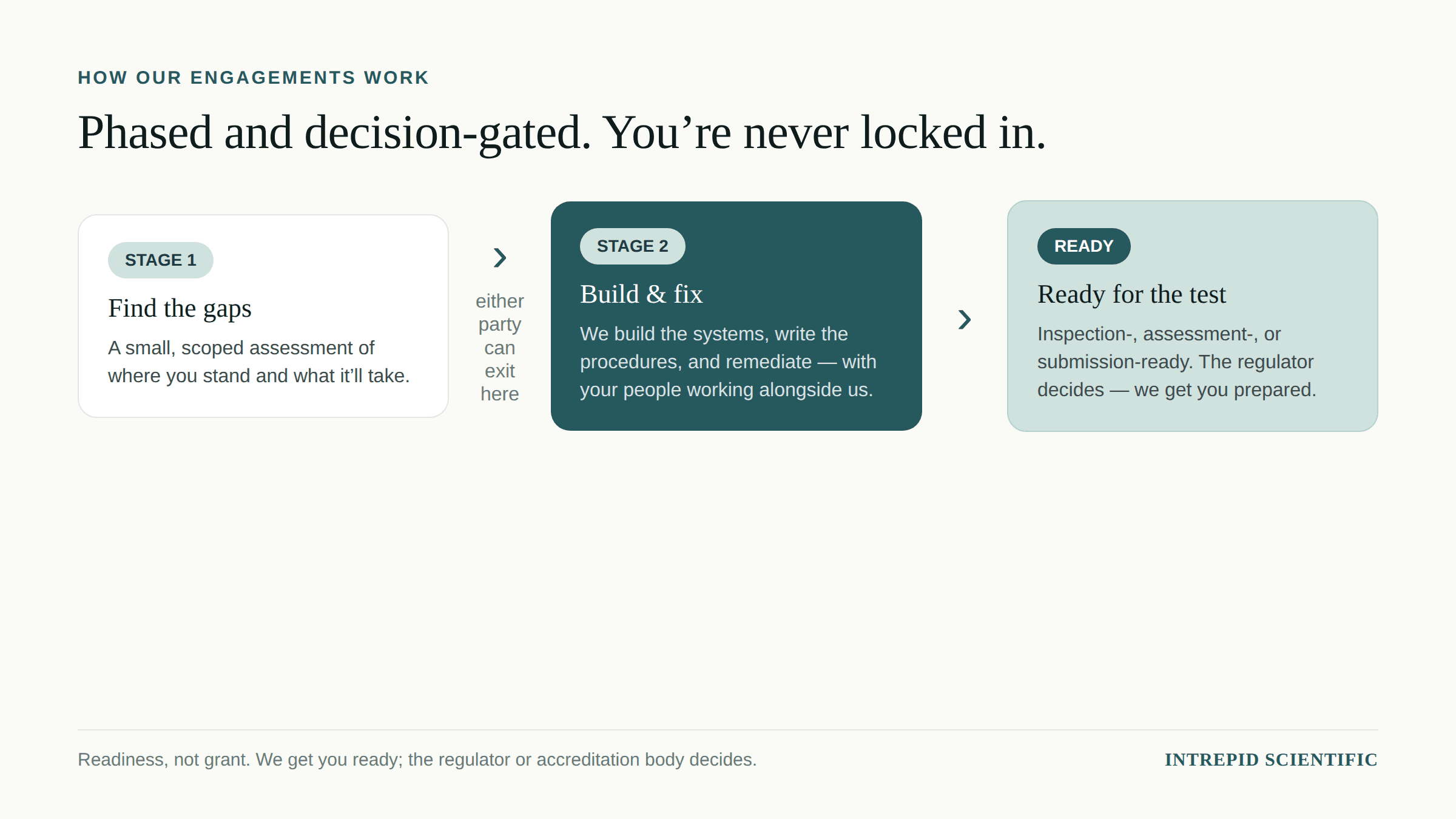
Phased, decision-gated. Either party may exit after Stage 1.

Every long engagement is broken into stages with explicit go/no-go gates. Stage 1 is a small scoping and gap assessment with mutual exit rights.

Readiness, not grant. Readiness, not outcome.

We get you ready for the assessment, the submission, or the inspection. Outside parties decide the outcome. We won't pretend otherwise.

Co-development. Client staff embedded from day one.

We don't develop systems or methods in a vacuum and hand them off. Your people work alongside ours so they own the deliverable when we leave.

Quarter-hour increments. Running ledger with every invoice.

Operational hygiene that signals discipline. You always know what you've spent and what you've gotten for it.

We will tell you in Stage 1 if this is the wrong tool.

If the diagnostic shows the proposed engagement isn't the right answer for your situation, we say so. A consultant who takes the engagement without that conversation is selling a product you may not need.
Category A

Productized offerings

Fixed-fee wedge engagements with defined scope and turnaround. Designed to answer a specific question or deliver a specific artifact, and to lead naturally into larger work only if it's actually warranted.

Process Authority Letter (PAL)

Process Authority designation and a signed PAL for finished-product SKUs — required for state filings, particularly cannabis-infused beverages under the California DCC framework (Title 4 Div. 19 CCR).

What we deliver

  • ·HACCP classification under 21 CFR Part 113, 114, or 120 (LACF / Acidified / Juice), or shelf-stable carbonated-beverage exception
  • ·GRAS and FDA Substances Added to Food review for every ingredient
  • ·Critical-limit calculations for the preservation system (acidulants, antimicrobials, emulsifiers, processing aids)
  • ·Per-SKU spec table, formulation table, and regulatory justification block
  • ·Signed PAL PDF, plus one revision round

Who leads

Andrew Samann (Process Authority of record on multiple state-approved cannabis-infused beverage SKUs) and Tess Eidem, PhD (PCQI under FSMA 21 CFR 117 Subpart C). Both credentialed, both named on the engagement.

The cleaner the data you give us, the lower the engagement cost.

Federal Pathway Readiness Diagnostic

A two-day fixed-fee diagnostic that tells a state-licensed cannabis cultivator whether they are positioned to file under 21 CFR § 1301.13(k) — the 60-day federal-registration window that opened with AG Order 6754-2026.

What we deliver

  • ·One day on-site: facility walk-through, records review across cultivation, post-harvest, storage, security, documentation, training, and quality; personnel interviews; closing meeting with preliminary findings
  • ·One day off-site synthesis
  • ·Gap Assessment rated against a four-tier rubric — Critical, Major, Minor, Observation
  • ·Project Management Plan proportionate to current state — prioritized remediation roadmap, sequencing, capability needs, recommended follow-on scope
  • ·Optional 60-minute virtual closing briefing within 10 business days

Who leads

Andrew Samann (DEA § 1301.13 framework; ICH Q7 lead auditor; previously led ASTM D37.02 QMS Subcommittee for Cannabis).

If the diagnostic shows you're already in good shape, we tell you that and you save a year of unnecessary consulting work.

Basic Design Qualification (10-hour retainer)

Fixed-fee 10-hour retainer that authors a User Requirements Specification for a proposed facility expansion or build-out, sets the DQ procedure into your QMS, and produces a punch list of open questions plus required engineering inputs. The wedge into a full DQ and commissioning program at a known price.

What we deliver

  • ·User Requirements Specification (URS) — room-by-room, populated from your architectural drawings, with process steps, environmental setpoints, surface finishes, utilities, gowning class, material and personnel access rules, plus a room-zoning matrix
  • ·One-page DQ procedure (PON / SOP) defining the URS → DQ → IQ / OQ / PQ → PV lifecycle and the Quality Risk Management linkage, slotted into your Controlled Documents List
  • ·DQ Punch List and Open Questions document — what work remains, who owns each line, what engineering inputs (HVAC, electrical, plumbing, BMS, security, architectural updates) the client must supply before DQ can close
  • ·Kick-off and scope-confirmation meeting with the QAP and project sponsor
  • ·Explicit out-of-scope list — full QMS rewrite, Validation Master Plan, Environmental Monitoring program, Contamination Control Strategy, HVAC commissioning, IQ / OQ / PQ execution. Each is a candidate follow-on engagement

Who leads

Andrew Samann (EU GMP, ICH Q7 lead auditor experience across 100+ engagements; previously led ASTM D37.02 QMS Subcommittee for Cannabis).

Bounded scope, defensible output. We don't try to rewrite the QMS in 10 hours — we deliver the URS, the DQ procedure stub, and the punch list of what comes next.

Category B

Project engagements

Custom, phased, decision-gated builds. Stage 1 is always a small scoping and gap assessment — at the end of it, either party may exit. We won't quote a fixed fee for Stage 2 and beyond until that scoping is done, because we don't know yet what we'd be quoting.

GACP + GMP Gap Assessment (Schedule III posture)

The primary commercial offering for state-licensed cannabis operators in the post-April-2026 federal-pathway environment. A scoped Stage 1 assessment that maps cultivation (GACP) and manufacturing (GMP) practices against the standards required by the operator's chosen downstream lane — state-medical-only plus § 1301.13(k) overlay, EU GMP / Annex 7 export, IND/NDA, CTM supply, or pharma partnership. Delivers gap findings, a sequenced remediation roadmap, a CAPA register, and a binding Stage 2 scope recommendation.

What we deliver

  • ·Structured pre-engagement intake (state licenses, controlled documents list, current SOP inventory, recent inspection / audit reports, open CAPAs, GMP equipment inventory, target downstream lane)
  • ·On-site assessment (typically 2-3 days, one cofounder lead plus supporting domain expert) covering cultivation, processing, packaging, vault, lab, and warehousing; records review; personnel interviews; closing meeting with preliminary findings
  • ·Gap assessment report — findings categorized by domain and severity tier (Critical / Major / Minor / Observation), each mapped to the specific clause of the target standard (21 CFR 111/117/211, EU GMP Part II + Annex 7 + Annex 1 + Annex 15, ICH Q7, or § 1301.13(k) overlay)
  • ·Prioritized remediation roadmap with sequencing dependencies, capability requirements, realistic timelines, and critical-path constraints
  • ·CAPA register (working spreadsheet) for client tracking
  • ·Binding scope recommendation for any Stage 2 follow-on engagement — fixed-fee or estimated based on assessment findings
  • ·Optional 60-minute virtual closing briefing within 10 business days

Who leads

Andrew Samann (overall framework; GMP / cGMP / DEA / ICH Q7 lead auditor; ASTM D37.02 Subcommittee experience). Kate Evans, PhD (cross-domain principal; ISO 17025 lead-assessor side; ASTM D8493-23). Tess Eidem, PhD (microbiology, GACP, EM; PCQI). Julie Kowalski, PhD (analytical chemistry, QC alignment, AOAC CASP Pesticide chair).

If the assessment shows you're already in good shape, we tell you that explicitly and you save a year of unnecessary consulting work. If not, the Stage 2 recommendation comes with a real number and a real plan.

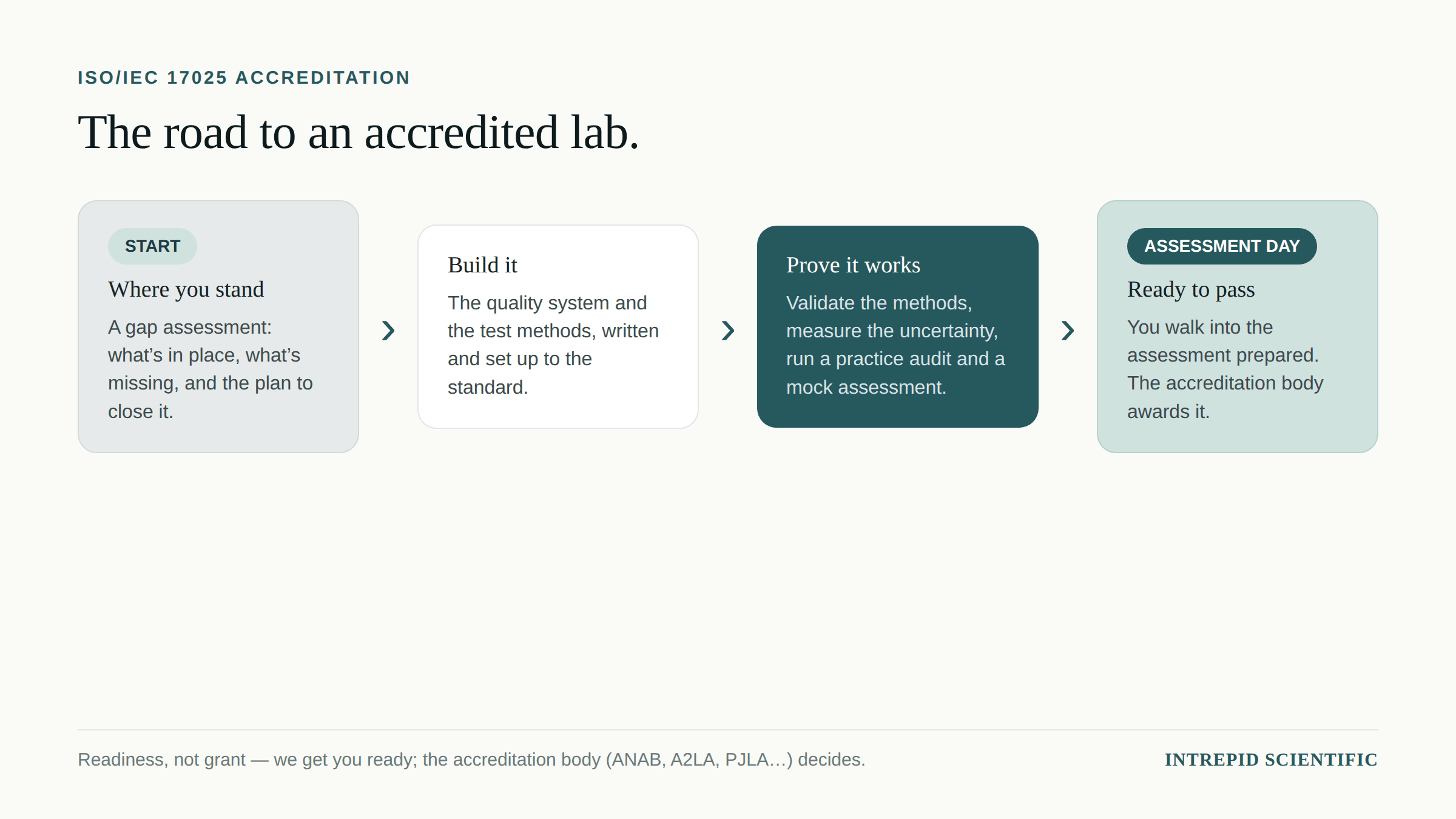
ISO/IEC 17025:2017 Lab Accreditation Readiness

Build a laboratory's management system and method portfolio to the point of passing an initial on-site assessment by its chosen accreditation body — PJLA, ANAB, A2LA, IAS, or other.

What we deliver

  • ·Stage 1 — Business-case confirmation (is 17025 actually the right tool for the goal?), gap assessment report with prioritized remediation backlog, scope-of-accreditation document, dated critical-path plan, one to two days on-site
  • ·Stage 2 — Quality manual and procedures (impartiality, confidentiality, structure, data and records control, nonconforming work, decision rules, CAPA, risk), method verification dossiers, ICH Q2 validation dossiers, measurement uncertainty budgets, proficiency-testing enrollment plan, internal audit and management review, remote mock assessment, up to two days remote AB assessment-week support

Who leads

Kate Evans, PhD (ANAB and A2LA lead assessor — assessor-side perspective is the differentiator), Julie Kowalski, PhD (analytical chemistry method validation), Tess Eidem, PhD (microbiology methods), Andrew Samann (QMS and cGMP alignment).

Readiness, not grant. We get you ready; the AB awards the certificate.

International or Greenfield Cannabis Testing Lab Build

Full lab program — facility, methods, QMS, validation, and accreditation readiness — for greenfield cannabis testing labs in markets where the regulatory framework demands EU GMP and ISO 17025 dual compliance from day one.

What we deliver

  • ·Phase 1 — Discovery and gap assessment (regulatory landscape, facility room-separation review, equipment inventory, scope-of-test decision, binding SOW)
  • ·Phase 2 — Method development and tech transfer (cannabinoids HPLC; pesticides LC-MS/MS and GC-MS/MS; heavy metals ICP-MS; mycotoxins; microbial plating and qPCR; moisture and water activity; terpenes; residual solvents; foreign matter; sample preparation)
  • ·Phase 3 — Validation per ISO 17025 Cl. 7.2 and EU GMP Annex 15, measurement uncertainty per EURACHEM/CITAC CG4, robustness, ruggedness, PT sample analysis
  • ·Phase 4 — QMS build (ISO 17025 Cl. 8; EU GMP Chapter 4 document architecture; ALCOA+ data integrity; environmental monitoring; OOS and OOT investigation)
  • ·Phase 5 — Accreditation readiness — mock pre-assessment, corrective actions, signed competency records per analyst per method

Who leads

All four cofounders. Julie leads analytical chemistry, Tess leads microbiology, Andrew leads QMS architecture, Kate operates as cross-domain principal.

Co-development. Client staff embedded from day one. The goal is not to develop methods for the client but to develop the client's people through the method development process.

Design Qualification + Qualification / Commissioning Program

The phased program that takes a Health-Canada-licensed cannabis facility (or any GMP facility expanding or being built greenfield) from URS draft through to an audit-ready DQ record and Commissioning Master Plan. Built around the nine questions every EU GMP / Annex 1 / Annex 15 auditor will ask on day one of an export-readiness audit.

What we deliver

  • ·Sequence A — Foundation (~11 hours): URS v1.0 finalization plus sign-off, Contamination Control Strategy (CCS) synthesized from existing risk assessments per Annex 1, DQ trace matrix skeleton
  • ·Sequence B — DQ close-out (~12 hours, after architect issues V1.0 drawings): DQ trace matrix complete (every URS line item linked to a design verification), training matrix tied to the V1.0 layout, Commissioning Master Plan first issue
  • ·Sequence C — Commissioning + qualification (~17 hours, during construction): HVAC IQ + OQ protocols (zoning, ΔP cascade, filter classes, ACPH, recovery times), equipment IQ protocol pack (dryers, trimmers, packaging line, vault), Environmental Monitoring program design + baseline-study protocol
  • ·Sequence D — Cleaning validation (~6 hours, when SOPs and equipment are stable): CVMP authoring, 3-batch validation supervised by us and executed by you, residue-limit chemistry partnered with your CRO

Who leads

Andrew Samann (DQ author / reviewer; EU GMP + ICH Q7 lead-auditor experience). Tess Eidem, PhD on CCS and EM program inputs. Julie Kowalski, PhD on equipment IQ analytical-method validation inputs.

The auditor's nine questions are immutable. The choice is how you're ready, not whether. Each sequence is individually scopable and approvable — you don't commit to the whole program at once.

Microbial Root-Cause Investigation + Preventive Controls Build

When a facility is failing microbial QC repeatedly — yeast and mold, bile-tolerant gram-negatives, Salmonella, E. coli, Aspergillus, Penicillium — we work the COA data, identify contamination vectors, design environmental monitoring, and (optionally) build a written preventive controls program modeled on FSMA 21 CFR Part 117.

What we deliver

  • ·Stage 1 (remote root cause) — COA review and failure-pattern analysis by room, strain, harvest week, and biological-input timing; root cause hypothesis report with prioritized contamination-vector ranking; environmental monitoring protocol (settle plates, surface swabs, water sampling) with equipment list; sanitation SOP recommendations; coordination with the testing lab for species-level ID
  • ·Stage 2 (on-site + preventive controls) — On-site facility evaluation; hazard analysis from cultivation through dry-room; written preventive controls (process, sanitation, supply-chain) Part 117-modeled; corrective-action procedures (hold/test/release); monitoring and verification program with recordkeeping; microbial risk assessment narrative; regulatory positioning summary

Who leads

Tess Eidem, PhD (PCQI; cannabis microbiology and bioaerosol depth) and Andrew Samann (QMS and regulatory framing).

Begin with Stage 1. Transition to Stage 2 only if remote work does not fully resolve. Most contamination problems are solvable from the data without burning travel hours.

Category C

Advisory, retainer, and expert work

Engagements with a different rhythm than a defined project. Some are matter-specific (a single litigation, a single regulatory submission). Some are ongoing (post-accreditation maintenance, on-call SME access). All bill on quarter-hour increments with a running ledger on every invoice.

Expert Witness + Litigation Support

Independent technical opinions, deposition and testimony, document review. Engage a single expert by domain, or a coordinated team of four under one engagement — with the proof point that all four cofounders have already collaborated on prior expert-witness matters together.

What we deliver

  • ·Pre-litigation scoping and data audit
  • ·Exposure-disease mapping for toxic-tort matters
  • ·Regulatory benchmarking (OSHA PELs, EPA, FDA, state regulators)
  • ·Gap and external-SME identification
  • ·Scoping reports written under attorney-client privilege (Prepared in Anticipation of Litigation)
  • ·Phase-2 transition pathway from consulting expert to testifying expert by separate addendum
  • ·Conflict-checked engagement letters and engagement-specific scope

Who leads

By matter domain. Tess Eidem, PhD on microbiology, bioaerosols, IAQ, building-environment exposure. Julie Kowalski, PhD on analytical chemistry, chromatography, pesticide residue. Kate Evans, PhD on toxicology, pharmaceutical analysis, cannabis cross-domain. Andrew Samann on cannabis cGMP, QMS, manufacturing.

Vetted alignment, not assembled team. Testifying together against a common opposing expert is the proving ground for trust under pressure.

Post-Accreditation / Compliance Retainer

Quarterly retainer with on-call senior SME access for post-accreditation maintenance, surveillance-audit prep, regulatory updates, OOS and CAPA review, and ad-hoc compliance questions.

What we deliver

  • ·Quarterly review meeting with the client's quality leadership
  • ·Bank of senior consultant hours rolled forward quarter to quarter
  • ·On-call escalation channel for regulatory and audit triggers
  • ·Annual review of QMS document set against current standard revisions

Who leads

Lead cofounder assigned by domain at engagement start; full team available for cross-domain questions.

Intrepid advises, builds, and trains. The client operates the system.

Federal Pathway / Schedule III Advisory

Advisory work tied to the April 2026 cannabis rescheduling — Single Convention SOPs, Public Interest defense documentation, DEA § 1301.13(k) registration package preparation, EU export pathway under § 1312.30, IND-track planning, and the integrated ICH / EU GMP / 21 CFR 211 build that follows.

What we deliver

  • ·Section 823(e)–(g) Public-Interest defense memo
  • ·Single Convention buy/sell-back SOP and batch-record template
  • ·Cultivation-area specification package (§ 1301.13(k)(6)(C))
  • ·DEA § 1301.13(k) registration submission package review
  • ·EU GMP gap assessment for export-pathway operators
  • ·IND/NDA-track planning for FDA-approved drug product candidates

Who leads

Andrew Samann on DEA framework, cGMP, ICH stack. Kate Evans, PhD on FDA test method submission. Julie Kowalski, PhD on analytical chemistry method validation for pharma.

The 60-day window is a registration sprint. The pharma pathway is a multi-year build. Don't conflate them.

Talk to us about an engagement

Send a note describing what you’re working on. We reply directly, from a cofounder. Quote-driven engagements; no boilerplate scopes.